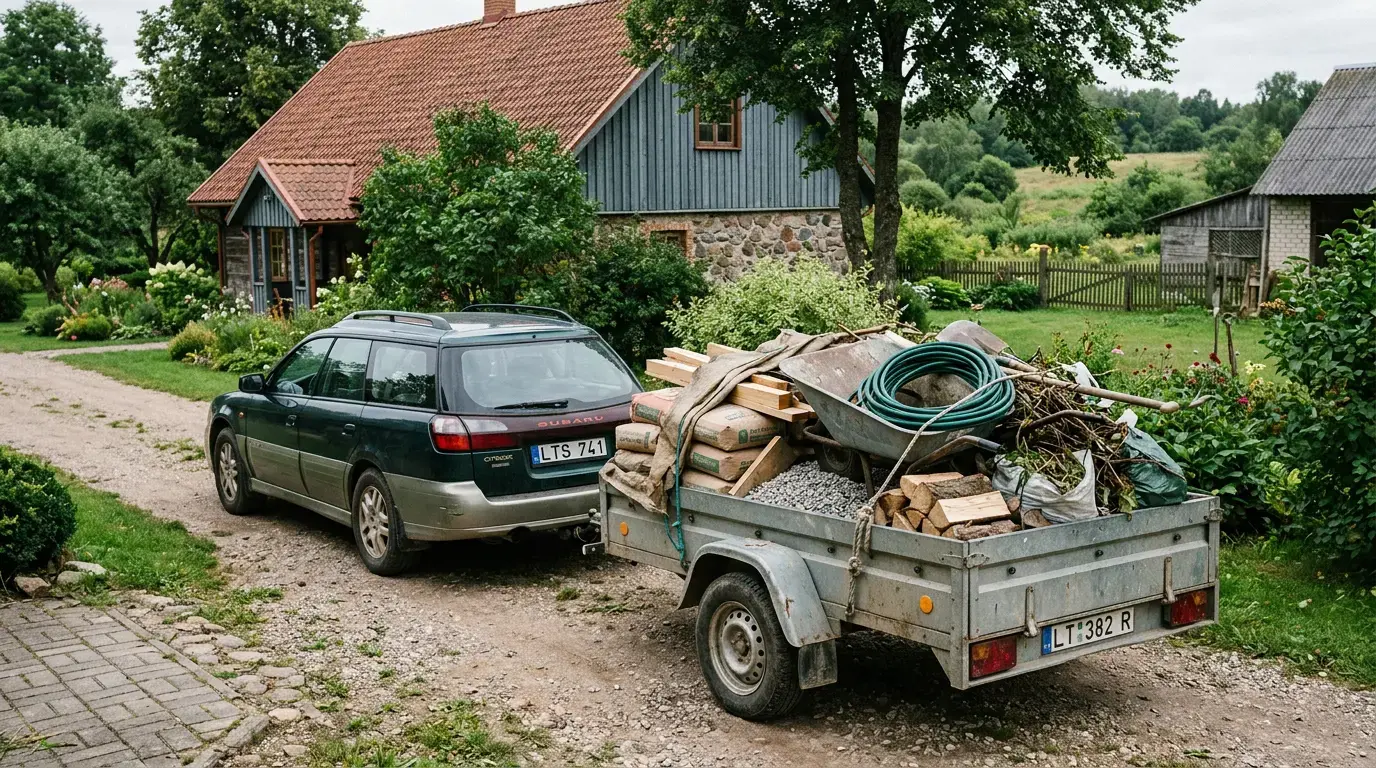
Trailer Insurance: When Is It Required, and Does Your Car Insurance Policy Cover It?
Imagine this weekend scenario: You’re hauling construction debris to the landfill with a small trailer attached to your car. As you take a turn, the trailer suddenly starts swaying, detaches, and crashes into your neighbor’s fence. The damage amounts to several hundred euros. You call your insurer, only to be asked a question you didn’t expect: “Does the trailer have its own insurance?”
Many drivers believe that as long as the trailer is attached to the car, it’s automatically covered by that car’s auto liability insurance policy. The reality is a bit more complicated. Depending on the trailer’s weight and the situation, it may require a completely separate policy, and damage caused by an unhitched trailer is sometimes not covered at all.
In this article, we’ll explain when trailer insurance is mandatory, what a car insurance policy actually covers, and how to avoid falling into a costly trap.
In ShortFor light trailers (up to 750 kg), third-party liability coverage is typically included under the towing vehicle’s policy as long as the trailer is attached. Heavier trailers (over 750 kg) require a separate third-party liability policy. If a trailer becomes detached and causes damage, coverage depends on the circumstances—so it’s worth checking the terms of your policy. The cost of trailer liability insurance usually ranges from a few to several dozen euros per year.
Why Many People Make a Mistake Regarding Trailer Insurance
The mistake is almost always the same. A person buys a trailer, registers it with Regitra, and continues to use it without a second thought, assuming that their car insurance covers everything.
This is partly true. But only partly.
In Lithuania, trailers are classified based on their maximum permissible weight. The threshold is 750 kg, and that’s what makes all the difference. Light trailers up to 750 kg (category O1) are treated one way, while heavier ones (O2 and above) are treated quite differently.
For Category O1 trailers, a separate TPVCA is usually not required as long as they are attached to a vehicle with valid mandatory insurance. There is only one condition: the trailer must be properly attached and used for its intended purpose.
Heavier trailers require a separate trailer TPVCA. And this is no longer a recommendation, but a legal requirement.
Warning: The most common misconception is that the towing vehicle’s comprehensive insurance (KASKO) or mandatory third-party liability insurance (TPVCA) automatically covers any damage caused by the trailer in any situation. A detached trailer constitutes a separate legal situation in which coverage is not guaranteed.
When Is Trailer Insurance Truly Mandatory?
In short—it all depends on the weight and how you use the trailer.
Trailers up to 750 kg (O1). Separate mandatory insurance is usually not required if the trailer is attached to an insured vehicle. The MTPL coverage of the towing vehicle extends to the trailer as long as it forms a single unit with the towing vehicle.
Trailers over 750 kg (O2 and above). A separate trailer liability insurance policy is required. Such a trailer is registered as an independent vehicle and is subject to separate requirements.
But is it worth getting additional insurance for a trailer, even if it’s lightweight? Sometimes, yes. If the trailer is expensive, carries valuable equipment, or you plan to rent it out to others—a separate policy can be a very sensible decision.
| Criteria | Trailer up to 750 kg (O1) | Trailer over 750 kg (O2+) |
|---|
| Separate TPVCA | Usually not required | Required |
| Coverage through the car insurance policy | While attached | No |
| Registration with Regitra | Yes | Yes |
| Vehicle inspection | Depends on the type | Required |
| Comprehensive insurance option | Yes, separately | Yes, separately |
One caveat: even when a car’s TPVCA “covers” a light trailer, this applies only as long as the combination remains intact. As soon as the trailer becomes unhitched and acts as an independent object on the road, the situation changes.
What happens if damage is caused by an unhitched trailer
This is where the most interesting—and potentially most expensive—part begins.
Imagine this: the trailer detaches while driving and rolls into another car on its own. Who is liable for the damage?
The general rule is as follows: if the damage resulted from improper coupling, faulty coupling equipment, or the driver’s negligence, liability falls on the trailer owner or the driver towing it. TPVCA may cover the victim’s damages, but the insurer has the right to seek recourse—that is, to demand reimbursement from the at-fault party if gross negligence is established.
Simply put, a trailer that has become detached is not an “automatic” insured event. Everything depends on the circumstances and the specific terms of the policy.
A detached trailer can legally be considered a separate source of damage, and coverage depends not only on whether you have a policy but also on how the incident is classified.
Trailer Insurance Costs: What to Expect
The cost of trailer insurance varies quite widely. However, in general, third-party liability insurance for trailers is one of the more affordable insurance products on the market.
Exact trailer insurance prices depend on the insurer, the type of trailer, its value, and the nature of its use—so the most reliable way to get specific figures is to compare offers from several insurers directly.
Insurance for camper trailers is a separate issue. Residential trailers (campers) are often valuable: they are equipped with appliances, furniture, and sometimes electrical systems. In such cases, third-party liability insurance alone is not enough. It’s worth considering comprehensive insurance (KASKO), which would cover theft, fire, or damage to the trailer itself.
Common Mistakes and How to Avoid Them
Mistake No. 1—assuming that weight doesn’t matter. The threshold between “insurance included” and “requires a separate policy” is exactly 750 kg. Check the trailer’s registration documents.
Mistake No. 2—failing to check the hitch equipment. A significant number of disputes involving detached trailers result in recourse claims precisely because the equipment was in poor condition. Check the hitch and safety chain regularly.
Mistake No. 3 – Forgetting comprehensive insurance (KASKO) for valuable trailers. Third-party liability insurance (TPVCA) only covers damage to third parties. If the trailer itself is damaged or stolen, you’ll be left with a loss without comprehensive insurance.
Mistake No. 4 – failing to assess the contents of the camper. Camper trailer insurance should cover not only the trailer itself but also the property inside it, if it is valuable.
Tip: Before buying a trailer, check its category on the registration certificate. If the weight exceeds 750 kg, make sure to get separate third-party liability insurance right away. This will prevent you from driving without the required insurance without even realizing it.
“I was certain that my car insurance covered the trailer. When the trailer detached and damaged someone else’s fence, I found out that my 1,100 kg trailer required a separate policy. I had to pay for the damage out of my own pocket.”—Mindaugas, trailer owner
Compare insurance prices in just a few minutes
Draudykle.lt will help you compare offers from the most popular Lithuanian insurers and purchase insurance online.
Compare prices →